
Your client testimonials could be some of the most powerful sales tools on your website.
But most small businesses are using them completely wrong.
A generic “Great service, highly recommend!” might sound nice, but it doesn’t really give potential clients a reason to choose your business over your competitors.
The best website testimonials do more than say that somebody had a positive experience. They show who you helped, what you did, and what changed as a result.
And reviews matter. So much so that 85% of consumers say positive reviews make them more likely to use a business.
After building more than 2,000 websites, we’ve seen what makes social proof really work.
In this guide, we’ll look at the four main types of testimonials every small business website should have, 12 website testimonial examples, where to put them, and how to collect better customer feedback.
4 Best Types of Testimonials Your Website Needs
Not all testimonials serve the same purpose.
Ideally, you want to collect several different types of client testimonials so that potential customers can see plenty of evidence that you deliver what you promise.
Here are four of the most important.
1. Customer Quote Testimonials
Quote testimonials are probably the simplest form of social proof.
These are short written testimonials from customers describing their experiences with your business.
You might get a quote from a customer:
- In person
- Through email
- From a text message
- During a customer interview
- From Google Reviews or another review platform
The more specific the quote, the better.
For example, compare:
“Great service! Highly recommend.”
With:
“The team redesigned our website in just three weeks. We immediately started receiving more enquiries, and our customers constantly tell us how much easier the new website is to use.”
The second testimonial example tells potential clients what the business actually did and what the customer experienced as a result.

2. Case Studies and Customer Success Stories
A case study goes much deeper than a short testimonial.
When you complete a project for a client, pull together all the information you need to communicate that project as a customer story.
Depending on your business, this could include:
- Sketches and illustrations
- Before-and-after photos
- Completed project photos
- A description of the problem
- The solution you provided
- A quote from the customer
- Measurable results
For example, a landscaper could create a detailed case study showing the garden before the project, photos of the work in progress, the finished result, and customer feedback.
Case studies work especially well for higher-cost services because potential clients often want more evidence before making a decision.
3. Video Testimonials
Video testimonials can be incredibly powerful because your website visitors get to see and hear a real customer talking about their experience.
And you don’t necessarily need an expensive production team to create testimonial videos.
You could:
- Hire a professional to film customers.
- Ask customers to record and send you a video testimonial.
- Record a video conference customer interview, with permission.
- Record a short testimonial on your phone after completing a project.

The key is authenticity. A natural 30-second video from a happy customer may be more compelling than a highly scripted testimonial.
4. Third-Party Reviews and Ratings
Finally, ask customers to review your business on third-party websites.
For many local businesses, that means Google Reviews. Depending on your industry, you might also collect reviews on Yelp, Alignable, Facebook, or industry-specific platforms.
These online reviews are particularly useful because the customer feedback isn’t simply coming from your own website.
You can then bring those positive reviews back onto your website as additional social proof.
For example, you could display your star rating beside a call to action or automatically pull your latest Google reviews into a testimonial carousel.
12 Website Testimonial Examples
So, what can all of this actually look like on your website?
Here are 12 customer testimonial examples to consider.
1. Short Customer Quote
Sometimes, a short quote is all you need.
“They made the entire process incredibly easy. I couldn’t be happier with the finished website.”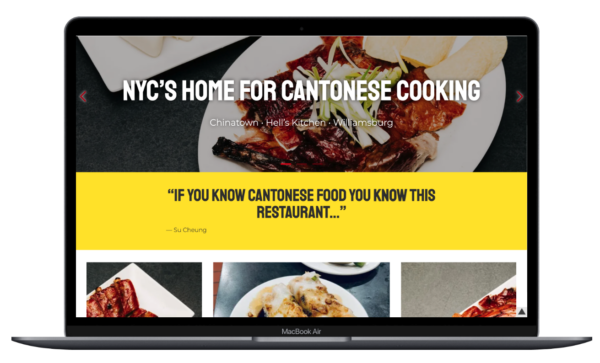
Short quote testimonials are particularly useful near calls to action, throughout service pages, or inside a testimonial carousel.
2. Results-Focused Testimonial
An effective testimonial can also highlight a specific result:
“Within two months of launching our new website, we were receiving twice as many online enquiries.”
Numbers make compelling testimonials because they give potential clients something concrete to consider.
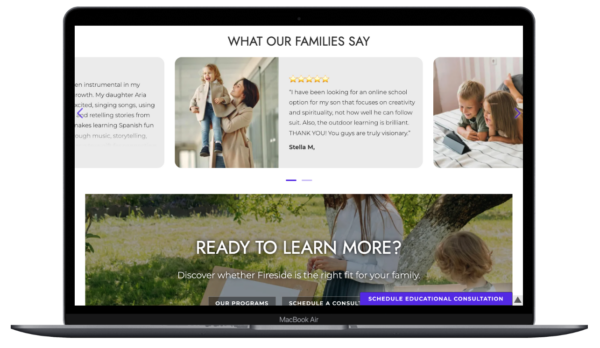
3. Problem-and-Solution Testimonial
Try collecting written testimonials that describe what the customer struggled with before working with you.
For example:
“I had tried building my own website twice and could never get it to look professional. The team took care of everything, and I finally have a website I’m proud to send customers to.”
This works because your prospective customer may recognize the same problem in their own situation.
4. Before-and-After Testimonial
If your work produces a visible transformation, show it.
A contractor, interior designer, landscaper, cleaner, or beauty professional could pair an image testimonial with before-and-after photos and a customer quote.
This gives visitors visual proof alongside the written customer review.
5. Detailed Case Study
For more complex services, create detailed case studies showing the complete customer experience.
Explain:
- The challenge: What problem did the customer have?
- The solution: What did your business do?
- The outcome: What happened as a result?
Add photographs, screenshots, statistics, customer quotes, or other supporting evidence wherever possible.
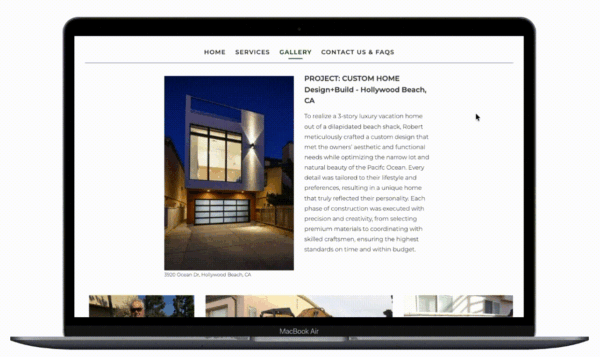
A good case study allows prospective clients to imagine what working with your business could look like.
6. Video Customer Testimonial
Instead of simply writing out a customer review, let your customer tell their own story.
For example, a 60-second video testimonial could answer three questions:
- What problem were you experiencing?
- Why did you choose this business?
- What was the result?
Keep it conversational. Your testimonial videos don’t need to sound like advertisements.
7. Recorded Customer Interview
If customers feel awkward recording their own video testimonials, invite them to a short video call instead.

Ask them about their experience and record the conversation with their permission.
You can use the full interview as a customer story or cut it into shorter testimonial clips for your website and social media.
You could even extract the audio to create audio testimonials.
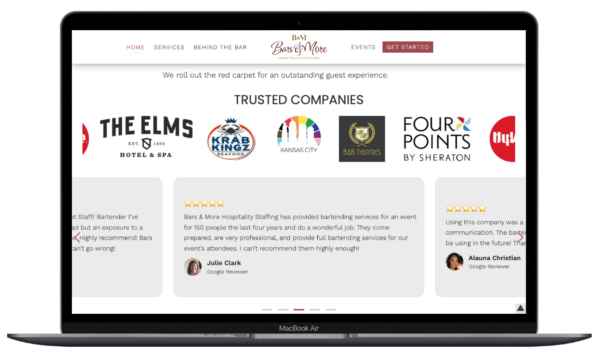
8. Google Review
If you’ve already collected great Google reviews, use them.
For example:
★★★★★
“Fantastic experience from start to finish. Communication was excellent, everything was delivered on time, and the finished product exceeded our expectations.”
Rather than manually adding every new review, consider using a website integration that automatically displays your latest reviews.
9. Star-Rating Badge
Testimonials don’t always need to take up a large section of your web design.
Something as simple as:
★★★★★ 4.9 average rating from 150+ customers
can add credibility beside a “Request a Quote,” “Book Now,” or “Get Started” button.
There’s good reason to make reviews prominent. Research from Northwestern University’s Medill Spiegel Research Center found that displaying five reviews increased purchase likelihood by 270% compared with displaying no reviews.
10. Social Media Testimonial
Don’t overlook social media testimonials.
If a customer posts about a positive experience with your business, ask whether you can feature that feedback on your website.
Depending on the platform and permissions, this could be a screenshot, embedded post, or customer quote.
These can feel especially authentic because visitors can see the feedback originally came from somewhere other than your website.
11. Industry-Specific Testimonial
One of the easiest ways to make testimonials more relevant is to organize them by customer type, industry, service, or problem.
For example:
“As a first-time restaurant owner, I had no idea what our website needed. The team walked me through everything and created a website that makes it incredibly easy for customers to find our menu and book a table.”
A restaurant owner reading this review will immediately recognize that the business has experience helping people like them.
The same idea applies to influencer testimonials, peer reviews, or a press review. The more relevant the source is to your target customer, the more useful that testimonial can become.
12. Testimonial Carousel
Finally, you don’t have to choose just one review.
A testimonial carousel lets website visitors browse several customer experiences without taking up an enormous amount of space on the page.
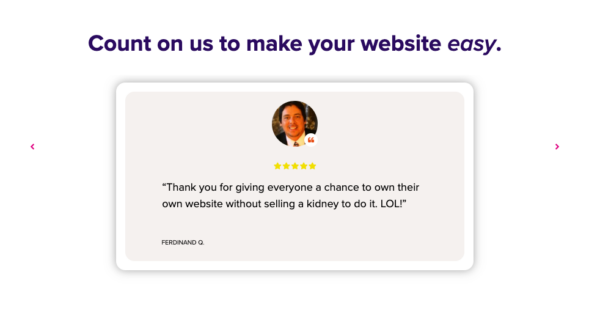
This is particularly useful if you have lots of positive reviews.
For example, you could create a carousel containing three to six Google reviews, each showing the customer’s name, star rating, and written feedback.
Just make sure your carousel is easy to navigate on both desktop and mobile.
Where Should You Place Testimonials on Your Website?
Once you’ve collected your customer testimonials, don’t hide them all away on one testimonials page.
There are three main places we recommend using them.
Service Pages
First, put relevant testimonials on your service pages.
The testimonial should back up the exact service you’re talking about.
For example, if you run a landscaping business and offer both lawn care and landscape design, don’t use the same generic review on both service pages.
Put a testimonial about a beautifully redesigned backyard on your landscape design page, and a review praising your reliable weekly service on your lawn care page.
This way, potential customers see feedback that relates directly to the service they’re considering.
Near Calls to Action
You can also sprinkle customer feedback near important calls to action.
For example:
★★★★★ 4.9 stars from 120+ Google reviews
[Request a Free Quote]
That small piece of social proof can give someone extra reassurance right when they’re deciding whether to take the next step.
On a Dedicated Testimonial Page
Once you have enough customer experiences to share, consider creating a standalone testimonial page.
You might call it:
- Customer Reviews
- Success Stories
- Client Successes
- Our Projects
- Customer Stories
Look at different testimonial page examples for inspiration, but don’t simply create a page containing dozens of random quotes.

A strong customer testimonial page should be easy to scan and, where possible, organize relevant testimonials into categories.
For example, you could separate reviews by service, industry, or project type.
How to Collect Customer Testimonials
You can’t create a great testimonials page without actually collecting feedback.
Fortunately, there are a few things you can do to get customer testimonials much easier.
Ask at the Right Time
Timing matters.
Try asking for a testimonial shortly after you’ve delivered the service, when the customer is happy, and the experience is still fresh in their mind.
If someone has just complimented your work, that’s another perfect opportunity.
Make It Incredibly Easy
Don’t simply tell someone, “Please leave us a review,” and expect them to figure out what to do next.
Make the process as simple as possible.
For example, if you’re at a job site and a customer gives you great feedback in person, write it down.
That evening, send them an email saying something along the lines of:
“You mentioned today that [quote]. Would you be comfortable with us using that as a testimonial?”
Then provide a direct link where they can leave an online review.
Ask Useful Questions
If you want more detailed feedback, guide the customer.
Ask questions such as:
- What problem were you trying to solve?
- Why did you choose us?
- What was it like working with us?
- What result did you get?
- What would you tell someone considering working with us?
These questions tend to generate much more useful responses than simply asking, “Can you write us a testimonial?”
Follow Up
People get busy. If somebody says they’ll leave a review and doesn’t, send a polite reminder. You don’t need to pressure them. A short follow-up with the review link may be all they need.
Keep Everything Organized
Create a spreadsheet and keep track of your customer testimonials.
You can include the customer’s name, company, industry, service purchased, testimonial, results, permission status, and links to any public reviews.
You can also create categories, making it much easier to find a quote from a particular industry or about a particular service later.
FAQs
How to Write a Testimonial for a Website?
The best testimonials sound like real customers rather than marketing copy.
A useful testimonial usually explains what the customer needed, what the business did, and what positive experience or result followed.
For example: “We needed a new website before our store opening, and the team handled everything. They launched it on time, and we’ve already received several enquiries through the site.”
Whenever possible, keep the customer’s own words rather than rewriting the testimonial to sound overly polished.
Where Do Testimonials Go On a Website?
Website testimonials can appear on your homepage, service pages, product pages, landing pages, about page, or near calls to action.
You can also create a dedicated testimonials page once you have enough reviews, case studies, and success stories.
The most important thing is relevance. Put each testimonial where it helps support the claim you’re making on that particular page.
How Long Should a Testimonial Be?
There’s no perfect testimonial length.
Short testimonials of one or two sentences work well near calls to action and inside testimonial carousels. More detailed written testimonials may be a paragraph or two.
Case studies and customer stories can be much longer because they’re designed to explain the entire customer experience.
Focus on substance rather than word count.
What Is a Short Testimonial?
A short testimonial is usually a brief quote describing a customer’s positive experience.
For example: “The entire web design process was professional and much faster than I expected.”
Short testimonials work best when they’re specific. “Great company!” might be shorter, but it doesn’t tell a prospective customer very much.